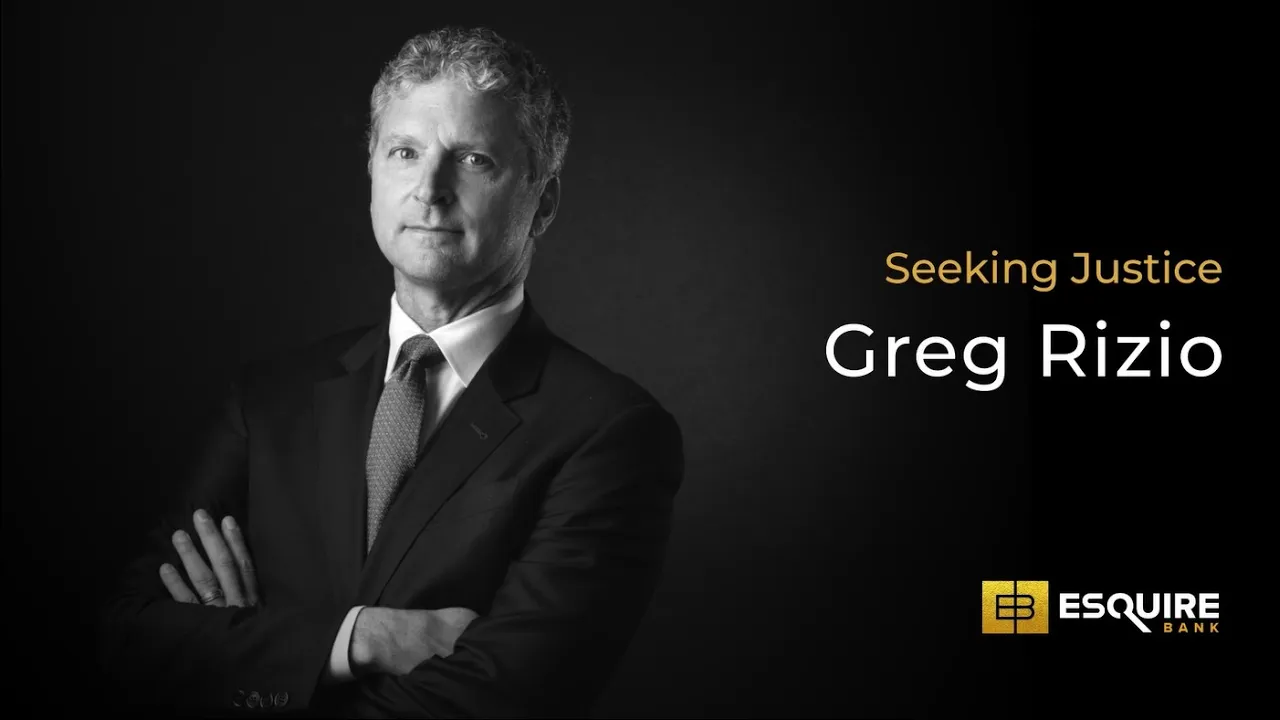
Greg RizioFounder and Senior Trial Attorney at Rizio Lipinsky Heiting, P.C.
Who helps rebuild what catastrophe takes from families?
Greg Rizio, that’s who.
Giving a Life Back: How Trial Lawyers Show Up for Families
Diana Palumbo has spent 20 years turning over a single sentence in her mind:
“The medical team can save a person’s life, but they can’t give that person a life back.”
It’s a sentence she never imagined saying, especially on the morning of April 8, 2005. Her daughter Samantha had just turned 16 three weeks earlier when she lost control of her car while driving to uptown San Dimas, California, and struck a heavy log fence running alongside the road. A pole from the fence came through the windshield and hit her in the head.
The injury was catastrophic: an open skull fracture, multiple broken facial bones, her upper jaw completely detached. First responders couldn’t intubate her in the field. They nearly didn’t call for the life flight because they didn’t think she would survive the wait. One of the responders, a father of five daughters, ordered the helicopter anyway. Samantha kept breathing until it arrived.
She was airlifted to LA County USC Hospital (now known as Los Angeles General Medical Center). That night, her parents were told she would not live until morning. The prognosis was documented in her medical records as “grim” and “likely to progress to brain death”.
But Samantha survived the night. And the next one.
And in the weeks that followed, a different question began to take shape. Not whether or not Samantha would live, but what her life would look like if she did and whether her family could afford to find out.
That type of question is one Greg Rizio answers for a living.
Trial Lawyers: Built for the Call
Greg Rizio is the senior partner and senior trial lawyer at Rizio Lipinski Heiting, P.C., a firm he founded in 1995 focusing on a specific kind of case: catastrophically injured individuals facing an institution, a city, an insurer, a corporation, with the resources to outspend and outlast them.
“We represent the Davids versus the Goliaths,” Greg explains.
“[As a trial attorney], you’re putting your own time and money into a case. Imagine working two, three [or] 10 years on a case, putting hundreds of thousands of dollars of your own money in, not knowing if you’re going to win. And if you lose, you lose that money and you never get that time back.”
That harsh reality filters who ultimately remains in contingency fee litigation. The lawyers who remain, in Greg’s experience, tend to operate from something closer to conviction than calculation. “The skills to be a great trial lawyer should be ingrained in who you are. You have to truly care for your client. You have to have integrity, because a jury will see through any falsities,” says Greg.
But what frustrates him most is how rarely that gets acknowledged from the outside.
“I wish people could see the hearts of trial lawyers – the heart of someone who is completely sold out for their clients. Everyone thinks, ‘You’re a lawyer, you’re an ambulance chaser, you make a lot of money.’ [But] none of that matters to a true trial lawyer. The true trial lawyer only cares about one thing: how do I help my client survive and get through this?”
This value is precisely why Diana Palumbo’s case resonated with Greg the way it did, even from day one.
One Call Can Change it All
Diana’s husband, Sam Palumbo, was the first to reach out. An insurance broker had referred the family to a personal injury attorney, who, after hearing the facts, told them the case was bigger than he could handle. He gave them Greg’s name.
But what that attorney passed along did not, at first, look like a case at all. “The police report said that Samantha was on her phone and was an inattentive driver who ran off the road and hit a fence,” Greg remembers. “Not the most appealing interview for a trial lawyer.”
He took the meeting anyway. “I will take interviews to give people comfort, even if I don’t think there’s a case. Because people deserve answers.”
For Diana, that early contact registered as something she badly needed but hadn’t yet been able to name. She had been at the hospital around the clock, researching clinical trials on her phone, double-checking medication with nurses to make sure Samantha’s care was accurate, and trying to coax a purposeful movement from a daughter in a minimally conscious state.
“Greg had a huge understanding of what my heart felt like,” Diana says. “He wasn’t overwhelming me with the details but letting me know that things were moving forward.”
Yet even from the beginning, what Greg had to tell the Palumbo family was harder than what Diana was prepared to hear.
“What Greg brought [us] early on was a dose of reality,” Diana recalls. “I could not imagine Samantha not waking up and being fully restored, mind, body, and soul. But from Greg’s experience, he knew that the long-term outcome, even if she did wake up, would require an incredible amount of care.”
Securing that care was Greg’s priority; what he was quietly preparing for. And those first weeks were vital to building the case, one that had the potential to carry Samantha through the rest of her life.
“Everyone thinks, ‘You’re a [trial] lawyer, you’re an ambulance chaser, you make a lot of money.’ [But] none of that matters to a true trial lawyer. The true trial lawyer only cares about one thing: how do I help my client survive and get through this?”
Greg Rizio
Founder, Senior Partner, and Senior Trial Attorney

“Everyone thinks, ‘You’re a [trial] lawyer, you’re an ambulance chaser, you make a lot of money.’ [But] none of that matters to a true trial lawyer. The true trial lawyer only cares about one thing: how do I help my client survive and get through this?”
Greg Rizio
Founder, Senior Partner, and Senior Trial Attorney
Greg’s team hit the ground running.
First, they tested the police report. Greg recruited an expert to walk the scene of the collision and determined quickly that the fence sat too close to the road under both California and Caltrans standards. Additionally, his team obtained Samantha’s phone records, which were cleared of the distracted-driving claim.
Then, unexpectedly, a handwritten note showed up on the Palumbo family’s front door. “It was from a neighbor we didn’t know, saying that for many years, he had been trying to get the city of San Dimas to remove that fence after his own friend died because of it,” says Diana.
That led Greg to an instrumental case breakthrough: that the log fence had killed three people before Samantha, in three different locations. The city had been warned, yet nothing had changed.
As the case moved toward trial, the city made a choice that all plaintiffs’ lawyers see at one time or another. “The city didn’t want to fix the fence,” Greg explains. “[Instead], they would hold that fence there until trial. And more often than not, they’d say, ‘Look, there hasn’t been an accident on that fence since. It’s all [Samantha’s] fault.’”
The city’s assumption was proved wrong, though, when a fourth fatality occurred at the same fence location just prior to Samantha’s trial. According to Greg, city officials were “enraged that they hadn’t fixed the fence.”
Greg would go on to ensure that the city replaced the fence, a foundational element to their eventual settlement. Still, despite progress being made, the financial demands of Samantha’s ongoing care were overwhelming.
Sam had already retired and Diana’s work had become the family’s main source of income. She stopped working the day of Samantha’s accident and never went back. And keeping Samantha insured ran $1,800 a month alone. What’s more, the family had already used a significant amount of its savings and depleted Diana’s IRA. Fortunately, the Palumbo family had a strong support system of neighbors and family friends: the Tom Marino Foundation in Glendora raised more than $100,000 for the family, and a friend sent them $2,000 a month, unprompted.
So, when the settlement arrived at last, Diana used part of it to repay everyone who had helped monetarily before, during, and after mediation. The rest went into the architecture of Samantha’s life post-accident: a wheelchair-accessible home on a flat street, a home exercise room, a PPO plan that could follow her to the best specialists, a Ford Explorer converted to carry her wheelchair, and a team of caregivers who provided not only support but companionship that became essential to Samantha’s emotional well-being.
Over the first eight years of recovery, Samantha underwent 28 surgeries to rebuild her face, jaw, and teeth. She had a feeding tube for four years. Then, beginning in 2016, she underwent four additional surgeries after her seizures stopped responding to medication. Though the settlement couldn’t undo the damage the fence had dealt, it could make a life possible going forward for Samantha, and, as Greg would learn, other lives he’d never meet.
What Is Justice?
Ever since the dangerous fence was replaced with a much safer white PVC alternative, Greg recalls that at least once a year when an accident occurs in that location, Diana calls him to say, “We saved another life last night.”
At the same time, if you were to ask Greg if he attained justice for the Palumbo family, he would tell you no. “Justice is getting a time machine, going back in time, and [making sure] it never happened,” he says. “It doesn’t matter how much money I make from this. [Samantha’s] life was stolen. There’s no justice for that.”
What Greg did instead was build the conditions under which her life could continue with joy and purpose. Since recovering, Samantha has gone paragliding off the cliffs of La Jolla. Last year, in 2025, two of Samantha’s personal assistants took her shopping at Target and Dollar Tree, where she navigated the aisles with her walker beside them. Walking through the stores alongside the girls brought back a feeling of normalcy. She was feeling like her old self again. “It wasn’t just that she was being cared for, but that she was one of the girls [again], out Christmas shopping,” Diana says. “The only way my daughter [got her] life back was through Greg and his team.”
“Now, I have peace of mind,” Diana says. “As [Samantha’s] sole parent (her father passed away in 2024), I know that her siblings will ultimately be responsible for her, but they won’t have to worry about the financial end of this. She has a great life care plan in place as a result of the work Greg did for our family.”
That peace of mind freed Diana to turn toward something beyond her own family. Though in truth, the Palumbo family had been on that trajectory long before Greg ever entered their lives.
At 15 years old, just one year before the accident, Samantha had launched a program called “To Mom with Love,” supplying domestic violence shelters with gifts children could give their mothers on Mother’s Day. In May 2005, while Samantha lay unresponsive in a hospital bed, one hundred children participated in the program.
Years later, Diana picked up that thread by launching C.L.U.B. life, which stands for Celebrating Life United with Brain Injury. C.L.U.B. life is a social recreation program for adults living with impairments from traumatic brain injuries or strokes. Where Samantha had built a way for children to reach mothers they loved, Diana built a way for survivors of brain injuries to reach one another.
The Partnership Behind the Fight
The kinds of cases Greg takes all depend on capital his clients are not in a position to provide. They tend to be years long, expert-heavy, and opposed by well-resourced institutions.
“The playing field is never level when you’re up against the monster corporations and insurance companies of the world,” Greg says.
This simple truth led him to find partnership in Esquire Bank.
“For me to do what I have to do, to pay it forward and take care of my clients, I need confidence that my bank has their side of it covered,” explains Greg. “[Esquire is] definitely in the chain of paying it forward. They pay it forward to me so I can pay it forward to my clients, and my clients can pay it forward to others.”
It’s a chain Greg believes outlasts any single case and any single lawyer.
“I helped one family, and now they’ve helped hundreds of families. And those families will help others too.”
In that way, Greg is a prime example how trial lawyers’ work doesn’t end when the case does. It keeps going one family at a time, long past the courtroom, into lives they might never know.
MORE THAN A CASE
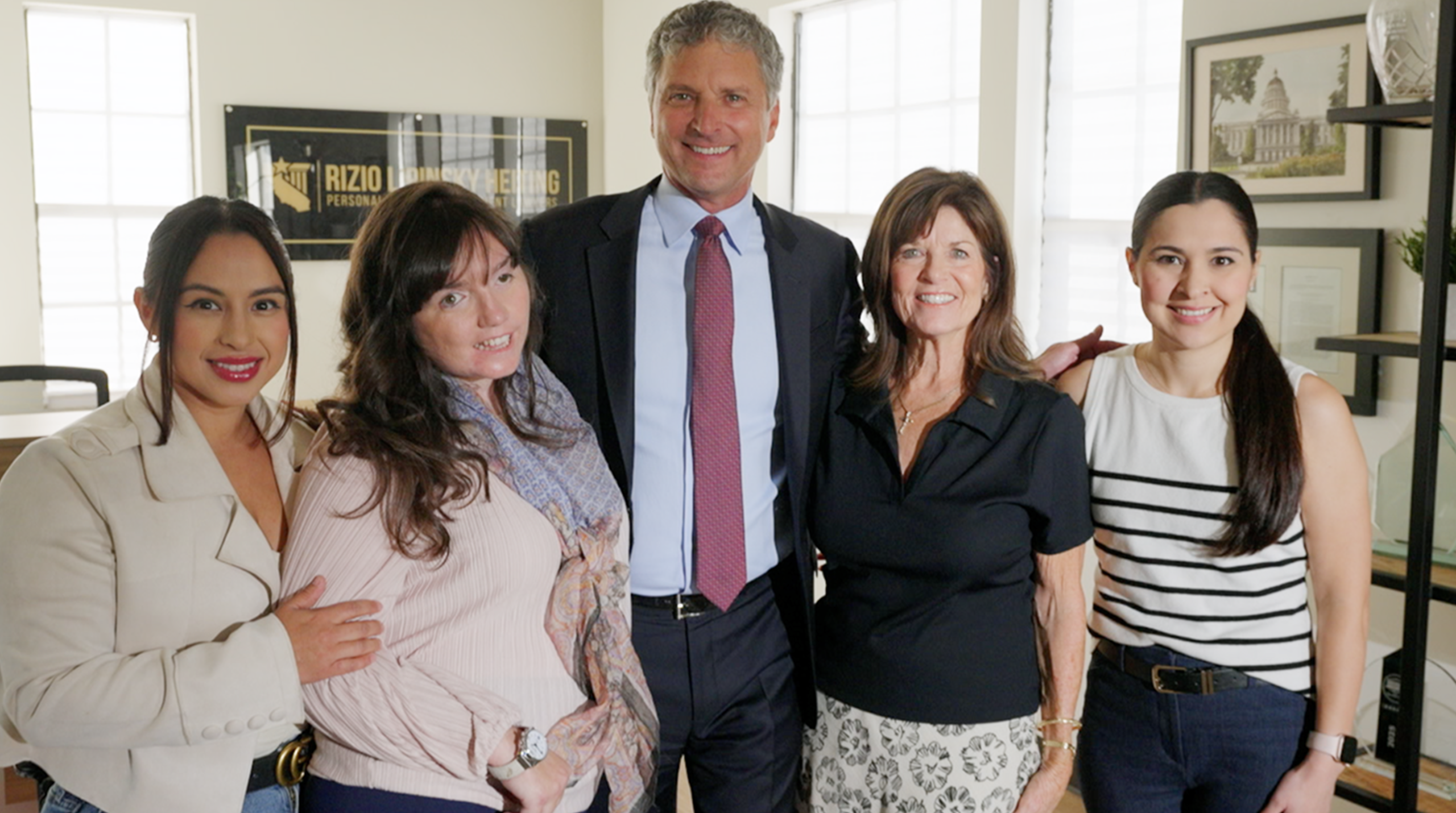
Greg pictured with the Palumbo family – the heart of one of his most defining cases – in 2026. As a trial lawyer, Greg never loses sight that behind every settlement and verdict are people whose lives have been reshaped, and that it’s his mission to help them move forward.
RECOGNIZED FOR THE WORK
Greg’s 2024 Lawyers of Distinction recognition reflects more than two decades of standing alongside clients and their families through the hardest chapters of their lives.