

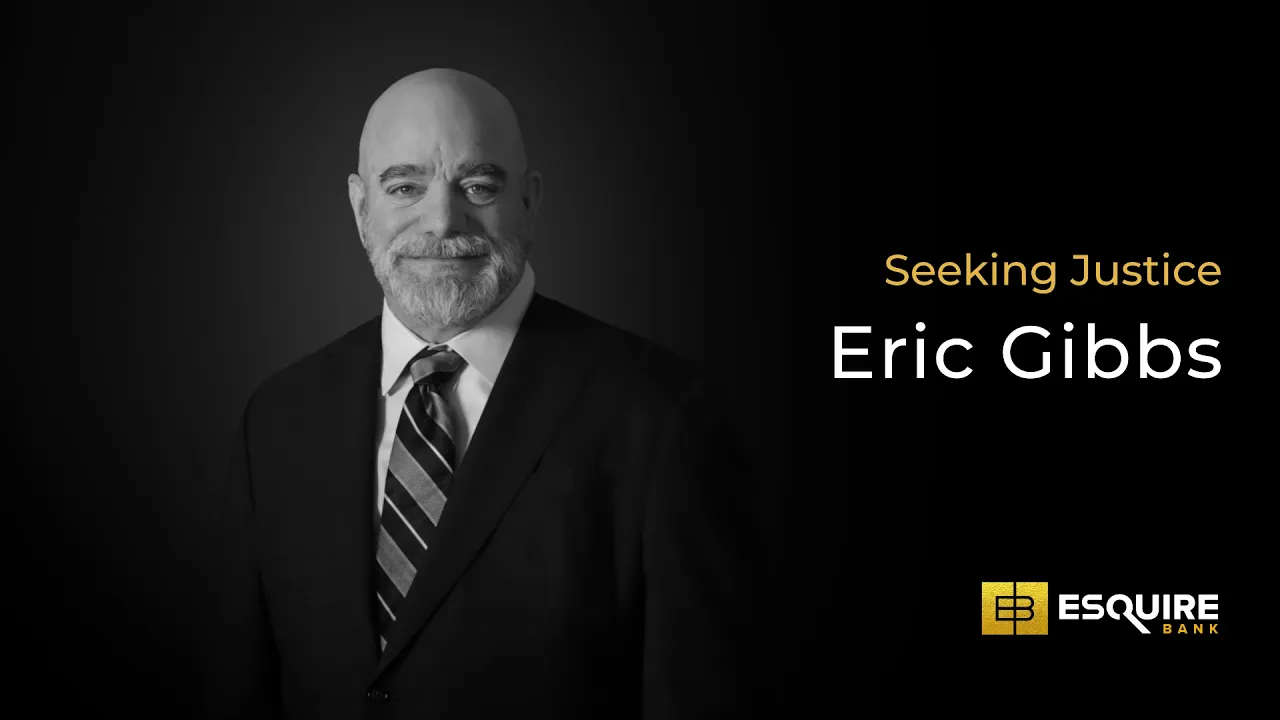
Eric GibbsFounder and Managing Partner at Gibbs Mura, A Law Group
Who stands up for people when the system fails to protect them?
Eric Gibbs,
that’s who.
Trial Lawyers Fight for Your Day in Court
The move to San Francisco wasn’t part of Eric Gibbs’ plan. He’d transferred universities, leaving San Diego for the Bay Area, and found himself cycling through restaurant and bar work that was going nowhere. On something close to a whim, he applied for a mailroom job at a small San Francisco law firm called Lieff Cabraser, and he got it.
“It opened up this new world for me that I never saw coming,” Eric recalls.
From that first day sorting mail, Eric became, as he puts it, a “law firm groupie.” He read everything he could find about the firm’s cases. He stayed late. He asked questions. The more he learned, the more certain he became that plaintiff’s litigation, standing up for ordinary people against powerful institutions, was calling to him like nothing else ever had.
“It was probably the most motivating thing I’d ever seen in my life,” says Eric.
Over the years, he rose from file management to paralegal work. Eventually, he moved to intake, and that was where something crystallized. Eric remembers taking call after call from people who’d been wronged in ways the legal system often brushed off, instances like someone calling because a company had ripped them off $84 and they just wanted the money back.
“The people who are calling you with their grievances are the kind of people that corporate America doesn’t expect to show up,” Eric asserts.
With this experience, Eric realized those calls weren’t just about dollars. They were about dignity. About what happens when someone gets taken advantage of by a system designed to outlast them.
This catalyzed Eric’s future practicing law: he attended law school, passed the bar, and spent the next few decades building one of the country’s most recognized plaintiff’s firms: Gibbs Mura Law Group.
Today, the contingency fee law firm is approaching a billion dollars in recovery for clients and classes. But his measure of the work has never changed:
“At the end of the day, through it all, it’s about the clients,” Eric says. “It just is and has to be.”
The Damage of Digital Exposure
At his Oakland, CA-based firm – with lawyers spread across the country from New York to New Orleans and Los Angeles, Eric and his team handle the full spectrum of civil litigation: consumer protection, financial fraud, mass torts, and data privacy. It was the latter where Eric would fight one of the most consequential battles of his career.
About 15 years ago, federal courts across the country were refusing to recognize “standing” for people affected by data breaches. In practical terms, it meant that a victim could have their most sensitive personal information stolen, suffer real and lasting harm, and still be told by a judge that they didn’t belong in court. The law simply hadn’t caught up to the reality of what digital exposure meant for real people.
This led to Eric and his team filing a case against a multinational software company after their massive breach exposed the personal records of millions of its users. The case was strategic as much as it was adversarial.
“In many ways, the purpose of that case was to overcome this ‘standing’ barrier,” Eric explains.
What they were asking the law to recognize was, at its core, straightforward: that people whose private information was stolen suffer real damages, and they deserve their day in court. Fortunately, the judge issued a 41-page decision in the plaintiffs’ favor. It was a landmark ruling that was cited favorably in more than 20 cases the year it was issued. It fundamentally changed who could walk through the courthouse door.
Not long after, Eric was appointed to lead the plaintiffs’ steering committee in a data breach case involving one of the largest healthcare companies in the US. That case affected approximately 80 million people and ultimately settling for $115 million, the largest data breach settlement in history at the time.
When Eric reflects on that period, he doesn’t frame it as a personal achievement. In his perspective, it was all about a shift in access.
“Convincing the courts that these people who are victimized by data breaches deserve a day in court and actually achieving that across the country – that’s something I’ll be proud of for the rest of my life.”
“Convincing the courts that these people who are victimized by data breaches deserve a day in court and actually achieving that across the country – that’s something I’ll be proud of for the rest of my life.”
Eric Gibbs
Founder and Managing Partner

“Convincing the courts that these people who are victimized by data breaches deserve a day in court and actually achieving that across the country – that’s something I’ll be proud of for the rest of my life.”
Eric Gibbs
Founder and Managing Partner
Injustice Found in the Fine Print
The “standing” barrier wasn’t the only wall Eric has spent his career dismantling. Recently, one of the most significant obstacles keeping everyday people out of court isn’t a legal doctrine, but a clause buried in the fine print of employment agreements: forced arbitration.
Forced arbitration is a practice that strips people of their right to sue in court. Instead, employment disputes get routed to a private arbitration forum – one the company helped design, and one that most people can’t afford to navigate alone. It is, in effect, a wall built around the courthouse.
“The forced arbitration system is great if you’re a wrongdoer, because no one can realistically show up and challenge you. But now, that’s being turned on its head,” says Eric.
Gibbs Mura, A Law Group currently represents more than 30,000 drivers working under a major tech company’s independent contractor delivery program. These are people who spend their days making deliveries and who, in Eric’s contention, are not being paid appropriately under California, Illinois, and Massachusetts law.
Under normal circumstances, this would be a class action lawsuit – the claims are common, the policies are the same, the harm is identical. Yet every one of those workers had signed a forced arbitration clause as part of their employee contract.
“That means if they want justice, they need to go to an arbitration forum, and they need to pay,” states Eric. “Let’s not kid ourselves: the purpose of that is to immunize [the company]. Because who’s going to do that?”
Instead of accepting that reality, Eric helped build a system to change it. Using technology, social media, and a team built to handle individual cases at scale, the law firm found a way to represent each of those 30,000 drivers individually in arbitration – with a real connection to the firm, real responsiveness, and real advocacy – without losing the human dimension that makes plaintiffs’ work meaningful.
“Similar to how the ‘standing’ barrier prevented people from having their day in court, forced arbitration prevents that, [too],” Eric says. “We give people their day in court. It’s part of what we do.”
A Strong Foundation for the Fight
Plaintiffs’ litigation runs on time, investment, and endurance. Cases can take years. Expert fees alone can run into the hundreds of thousands. And in contingency fee work, a law firm carries every dollar of that risk before a single verdict is ever announced.
In Esquire Bank, Eric found a banking partner who understood those intricacies of a contingency fee business model.
Through Esquire’s working capital line of credit, the law firm sustained its first five or six years of growth, allowing Eric and his team to pursue the cases that mattered rather than the cases that were just safe.
“Without Esquire Bank, we wouldn’t be in a position to fight for justice,” he says.
Building the Next Generation of Trial Lawyers
With each new generation of lawyers – from those still in school, to those completing internships, to those taking their first cases – continuing education remains a vital part of upholding the justice system. If and when there are gaps, both the industry and everyday people suffer.
This realization came to Eric a few years ago during a talk he gave at a law school. Standing in front of a room full of students, it suddenly became clear: they had no idea that trial attorneys were doing the same work as the giant law firms they’d been told to aspire to.
“When you’re in law school, what the school really tells you about are those [big] law firms,” Eric explains. “Absent from that mix is what we do.”
This experience led Eric to help form the National Plaintiffs’ Law Association, a nationwide student-run organization designed to put trial law work in front of law students. Additionally, he was also direct about another gap he saw in the profession: the lack of equal opportunity for law students from different walks of life.
To address it, he helped create the Mason Gibbs Plaintiff’s Pathway Fellowship to specifically reach students from a broad range of backgrounds and create a pipeline into careers in civil litigation. The results are both personal and forward-looking.
“I’ve had the pleasure to work, speak, and interact with law students who I know are going to be powerhouse plaintiffs’ lawyers,” Eric notes.
“These are students who could just as easily go into Big Law. But now they’ve found us. They’ve found out what we do. And to me, that’s a game changer.”
Eric has spent nearly four decades making sure that those corporate America doesn’t expect to take action, like the overlooked breach victims and employees – have someone in their corner when they do. Now, he’s making sure the trial lawyers who come next will be ready to do the same.
STRENGTH IN NUMBERS
For Eric, collaboration isn’t just a practice – it’s a necessity. Taking on the most powerful corporations in the country demands a team that thinks collectively, moves efficiently, and never loses sight of who they’re fighting for.

A RECORD OF EXCELLENCE
For 15 consecutive years, Eric has earned a place on the Super Lawyers list – one of the legal profession’s most respected peer-recognition honors – reflecting his commitment to his clients and the legal community.